
Harbanspura & RUDA · Lahore
The Factory Behind
the Floor.
Most stone in Lahore is sold by people who did not cut it. Here is what changes when the company quoting you owns the saw.
A shop sells stone.
A factory answers for it.
There is a distinction in this trade that almost nobody explains to customers, and it decides more about how a project goes than the stone you pick. Most marble and granite businesses in Lahore are traders. They buy finished slabs from someone who cut them, hold a little stock, and sell it on. Nothing about that is dishonest — it is a legitimate way to run a business, and many do it well.
But it changes what happens when something goes wrong. When a slab arrives with a hairline fissure, when a book-match does not line up, when a batch comes through two shades warmer than the sample, a trader has to go back up the chain and ask. Sometimes the answer takes weeks. Sometimes it never comes, and the customer is quietly told that this is simply how natural stone is.
A production house has nowhere to send that question. We buy blocks — at the quarry face in Balochistan, Khyber Pakhtunkhwa and Gilgit-Baltistan for Pakistani stone, and at origin in Italy, Iran and Türkiye for imports. We saw them, polish them, cut them and install them ourselves. If a floor we laid is wrong, there is no third party in the story. That is uncomfortable in the moments when something has gone wrong, and it is precisely why we are careful in the hundreds of moments before.
Our foundation was laid in 1995 as a building-materials yard in Harbanspura. In 2008 it became a full marble and granite production house. The yard still runs, serving the same community that first trusted it.
Inside the Facility
From raw block
to laid floor.
01Block Selection
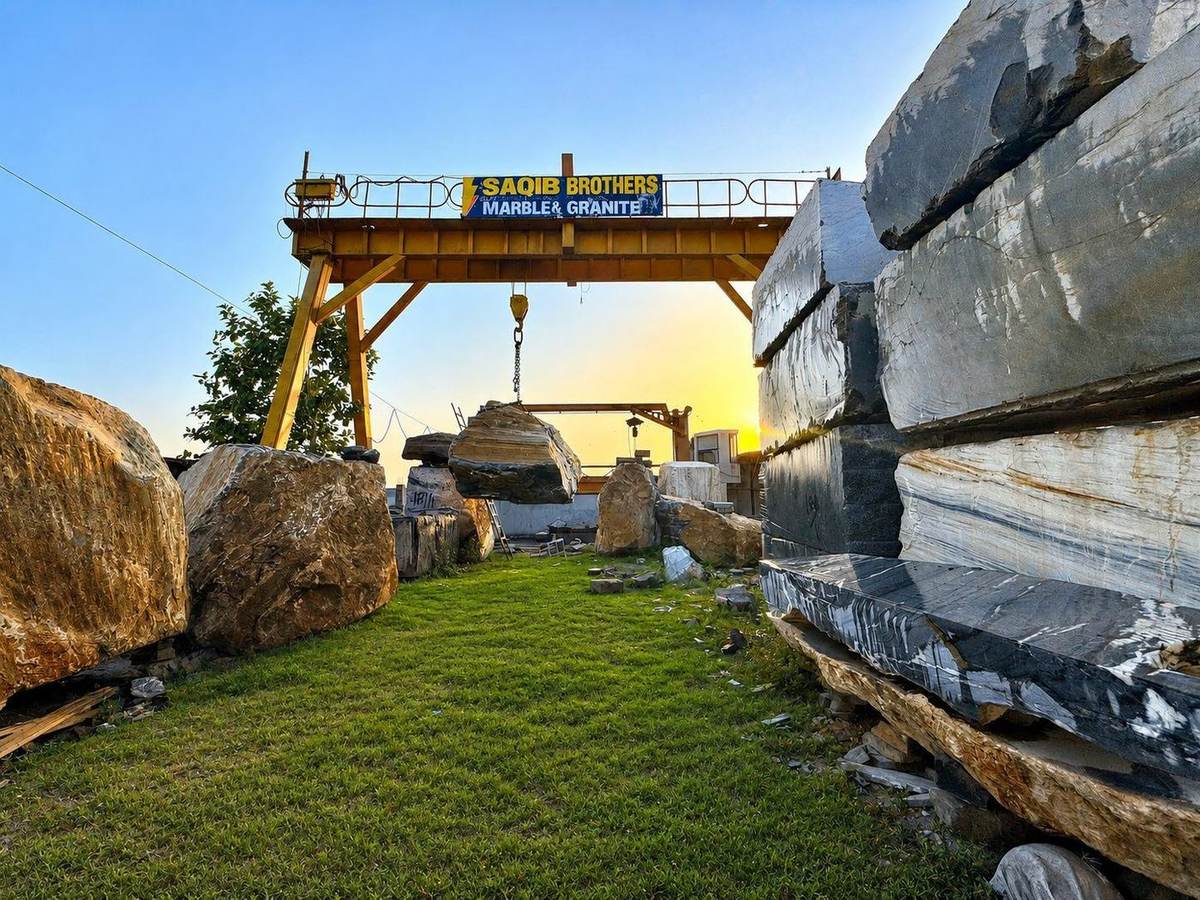
Bought at the QuarryEvery stone begins as a block we chose ourselves, in person. For Pakistani stones that means standing at the quarry face in Balochistan and KPK, reading the cut for fissures and colour consistency before committing. For imports it means selecting at origin rather than buying a container sight-unseen from a photograph. This single decision determines more about the finished floor than everything downstream, and it is the step most cheaply skipped.
Explore →02Gang Saw
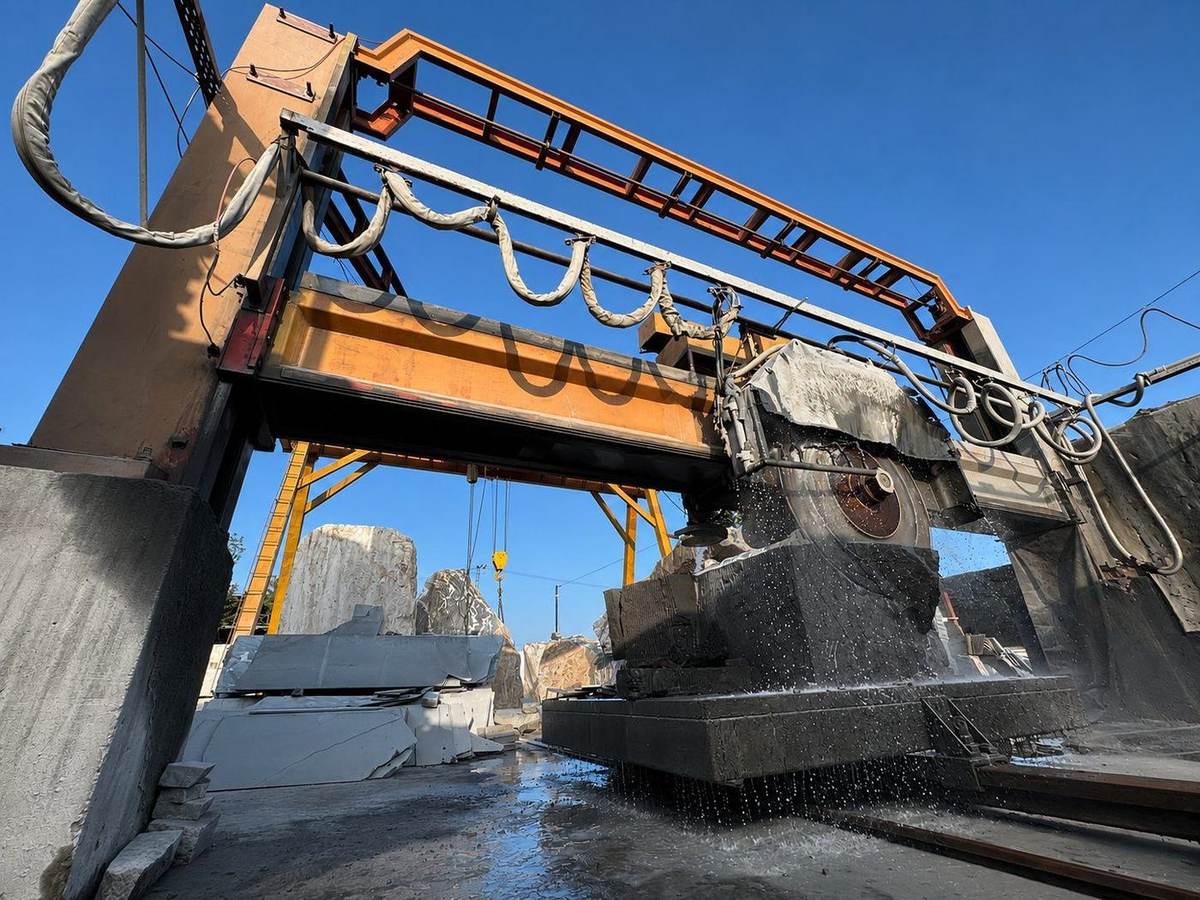
One Block, Twelve SlabsThe block goes onto the gang saw, where a bank of blades works through several tonnes of stone under constant water cooling over many hours. Cutting speed is a genuine trade-off: pushed too hard, the blades leave a wavy face that later polishing can never fully correct. We run slower than we could. It costs us throughput and it is the reason our slabs come off the line flat.
Explore →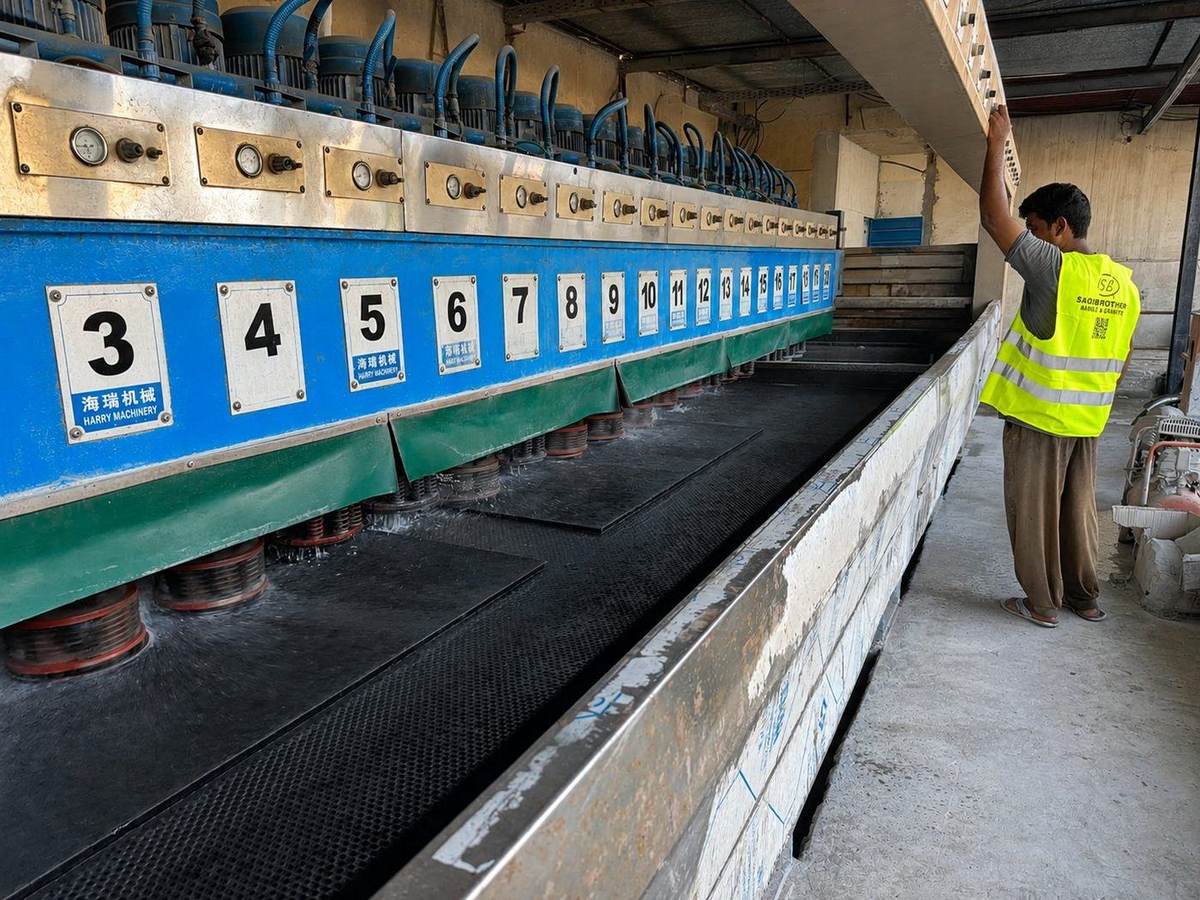 03
03Eight-Stage Polish
Where Gloss Is EarnedThe sawn slab passes under eight successive polishing heads, each finer than the last, from coarse abrasive to a final mirror. Most of the difference between stone that still looks good in five years and stone that dulls in one is decided here — a surface stopped short at stage five looks almost identical in the yard and behaves nothing like it under a mop. We finish the full sequence.
Explore →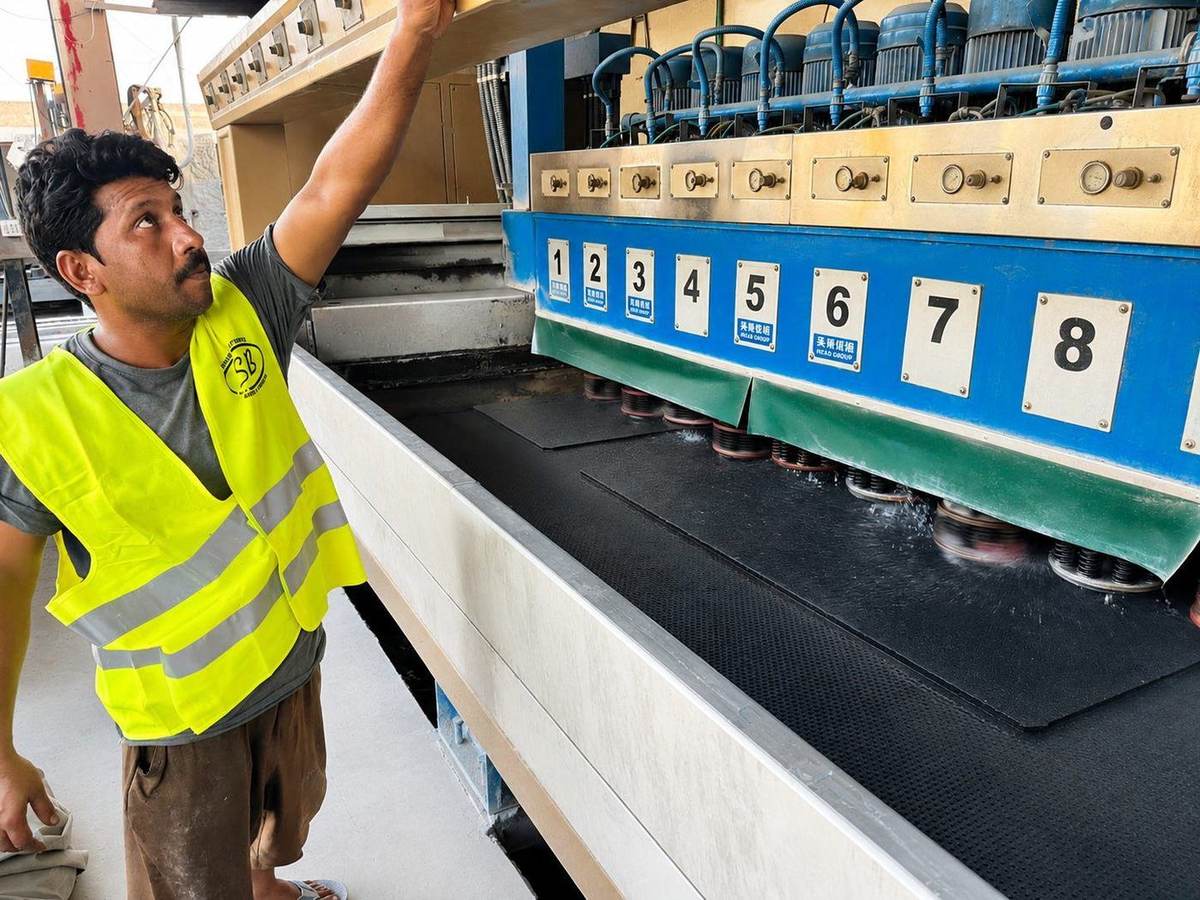 04
04Italian CNC
Cut to the MillimetreYour architect’s setting-out drawing goes to our Italian CNC line, which cuts to ±1 mm — mitres, cut-outs, bullnose profiles, drainage grooves, anti-slip nosings on stair treads. Doing this at the factory rather than on site means no dust, no improvisation, and pieces that arrive numbered in laying sequence. Site crews lay rather than measure, which is how a floor gets finished on the day it was promised.
Explore →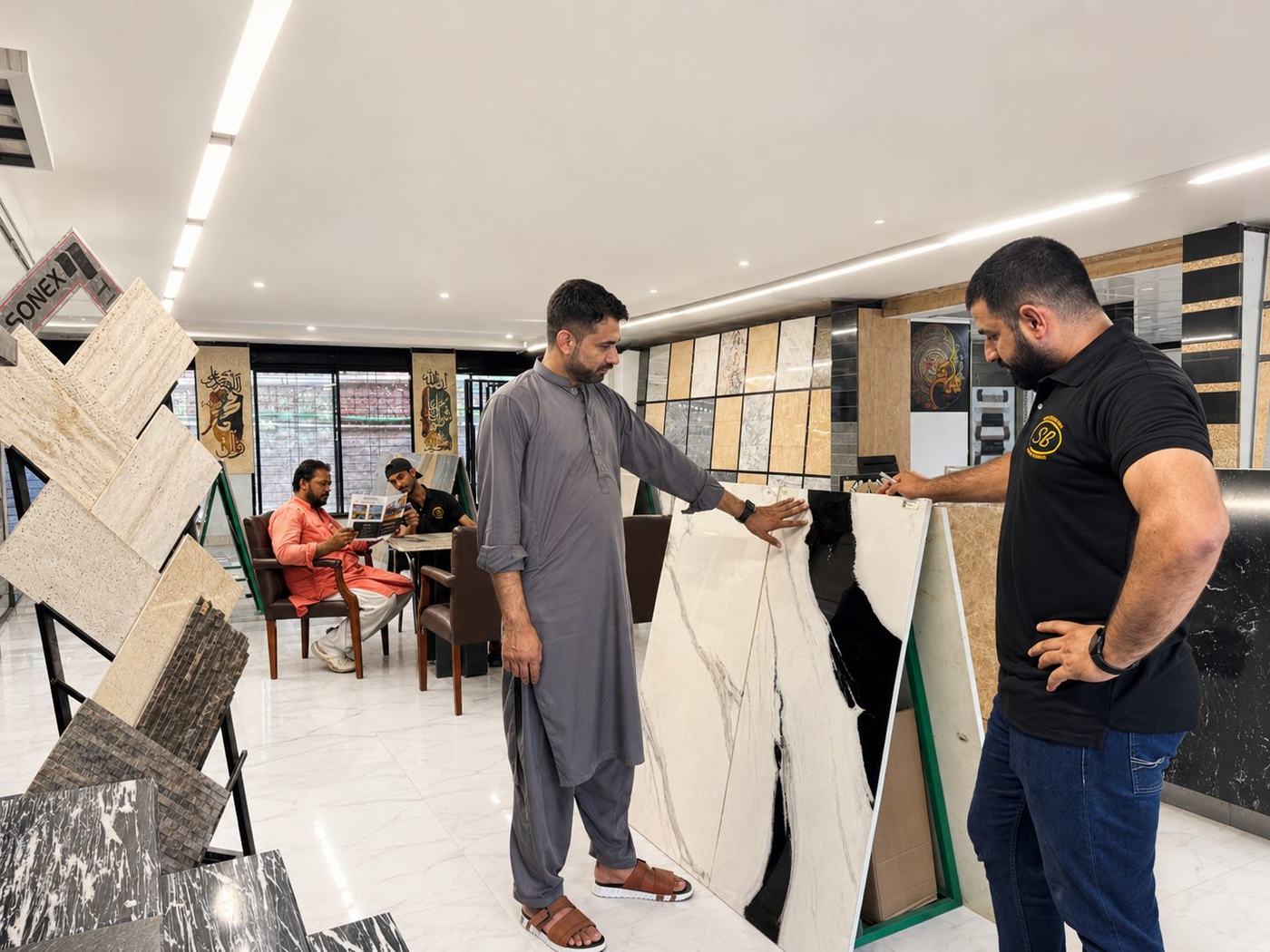 05
05Book-Matching
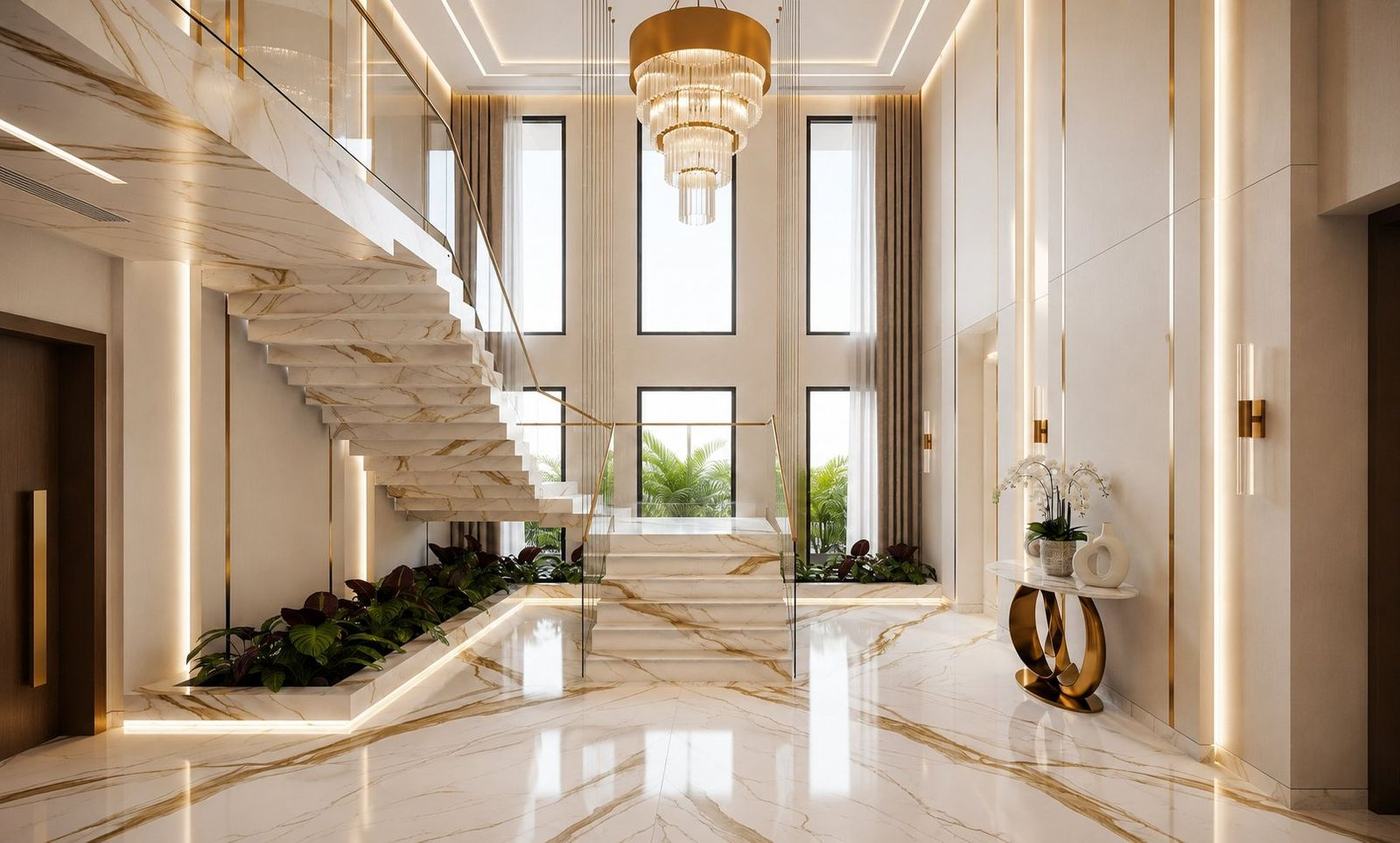
Approved Before CuttingFor feature walls and double-height halls we lay the sequential slabs out on the yard floor, mirror them into their pairs, and photograph the layout for your approval before a single cut is made. It is the one decision in a stone project that genuinely cannot be undone, so it does not happen without a signature. Most projects that go wrong on a feature wall went wrong at exactly this step.
Explore →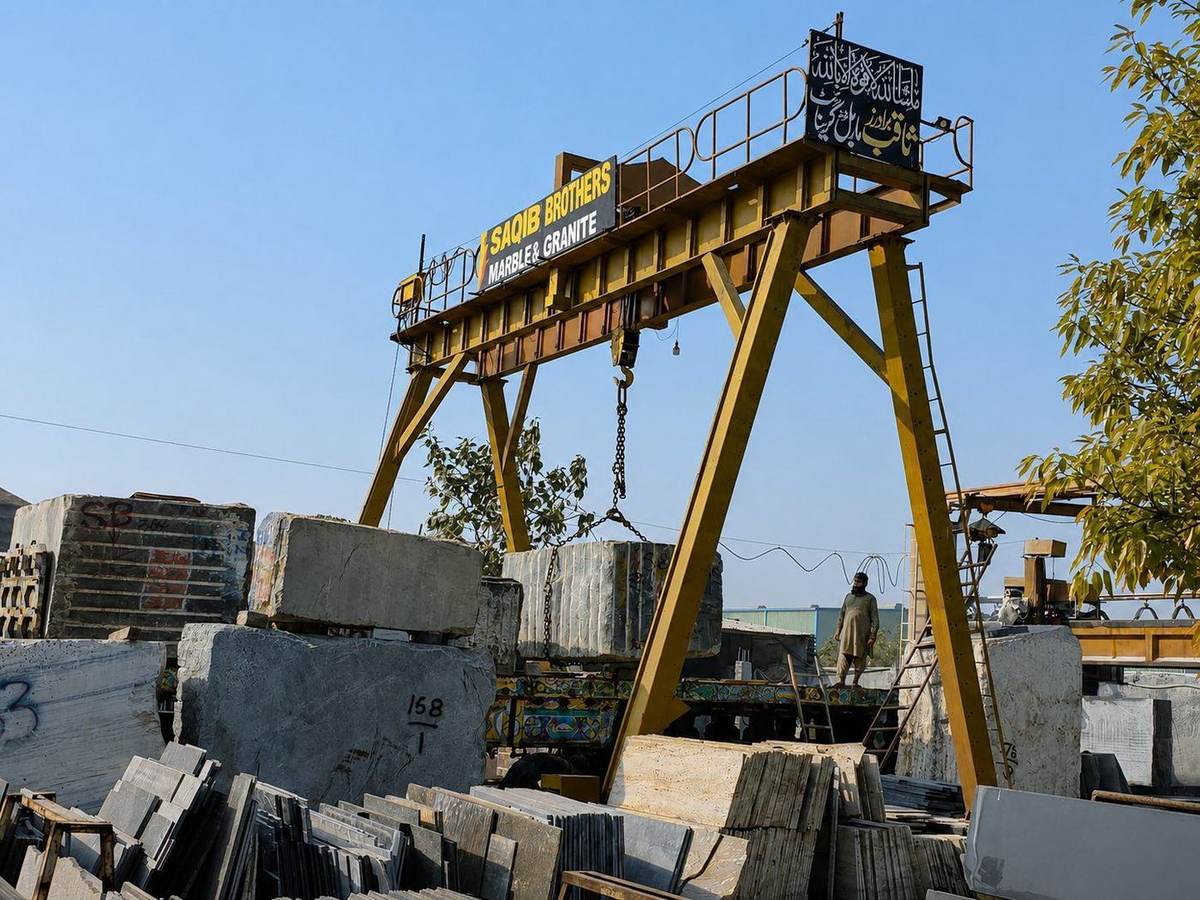 06
06Delivery & Fixing
Our Own CrewsCut material is loaded and delivered on the date quoted, and laid by crews who have set our stone for a decade. We do not subcontract fixing, because the joint that follows the veining and the joint that ignores it look completely different and only one of them was done by someone who cared. Across DHA, Bahria, Model Town, Gulberg, Cantt and the wider city.
Explore →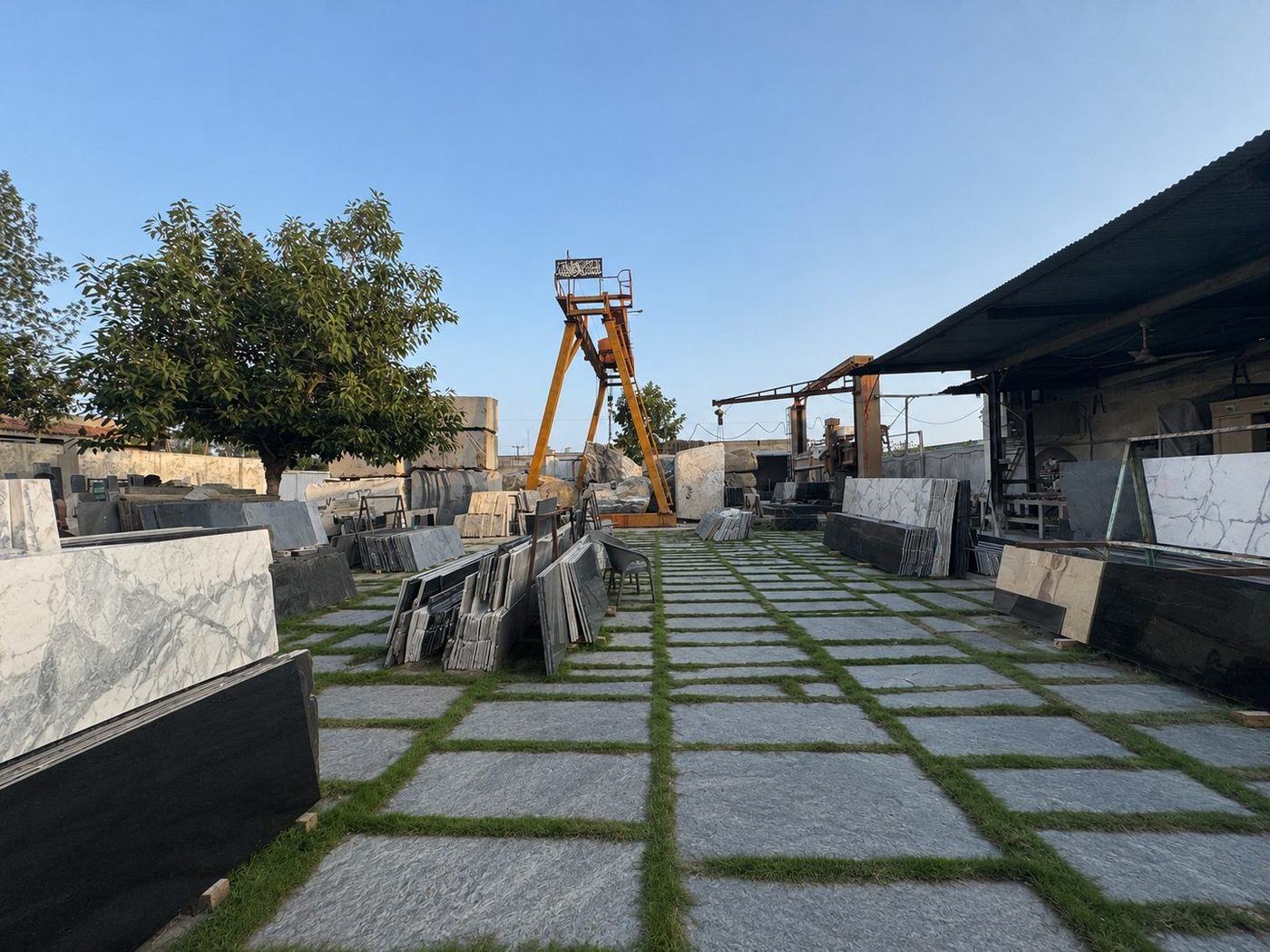
What buying factory-direct
actually saves you.
The obvious answer is margin, and it is real — one accountable margin instead of two or three stacked between the quarry and your floor. But in practice the savings clients notice most are not the ones on the invoice.
The first is consistency across large areas. When you cover a six-thousand-square-foot floor plate, the enemy is not price, it is variation between lots. Because we buy and cut whole blocks, we can reserve a single lot for your project and hold it — so the last slab laid matches the first, and the colour does not shift halfway down a corridor. A trader buying finished slabs from multiple sources genuinely cannot promise that.
The second is time. Cutting, edge profiling and grooving all happen at RUDA before anything is loaded, so site work is measured in days rather than weeks. For commercial refurbishments — a bank branch, a hotel lobby, a retail unit trading the next morning — that is the difference between a job that can be done and one that cannot.
The third is that problems get solved rather than explained. A slab that breaks in transit is recut from the reserved lot. A cut-out in the wrong place is remade. Held stock from the same lot means a repair three years later still matches the floor around it. None of that is possible if the material came from a container that was sold out months ago.
“Gang saws, cutters and an eight-stage polishing line at RUDA — no middlemen between the block and your floor.”
Two addresses,
one standard.
We run from two locations in Lahore and they do different jobs, which is worth knowing before you set off to visit.
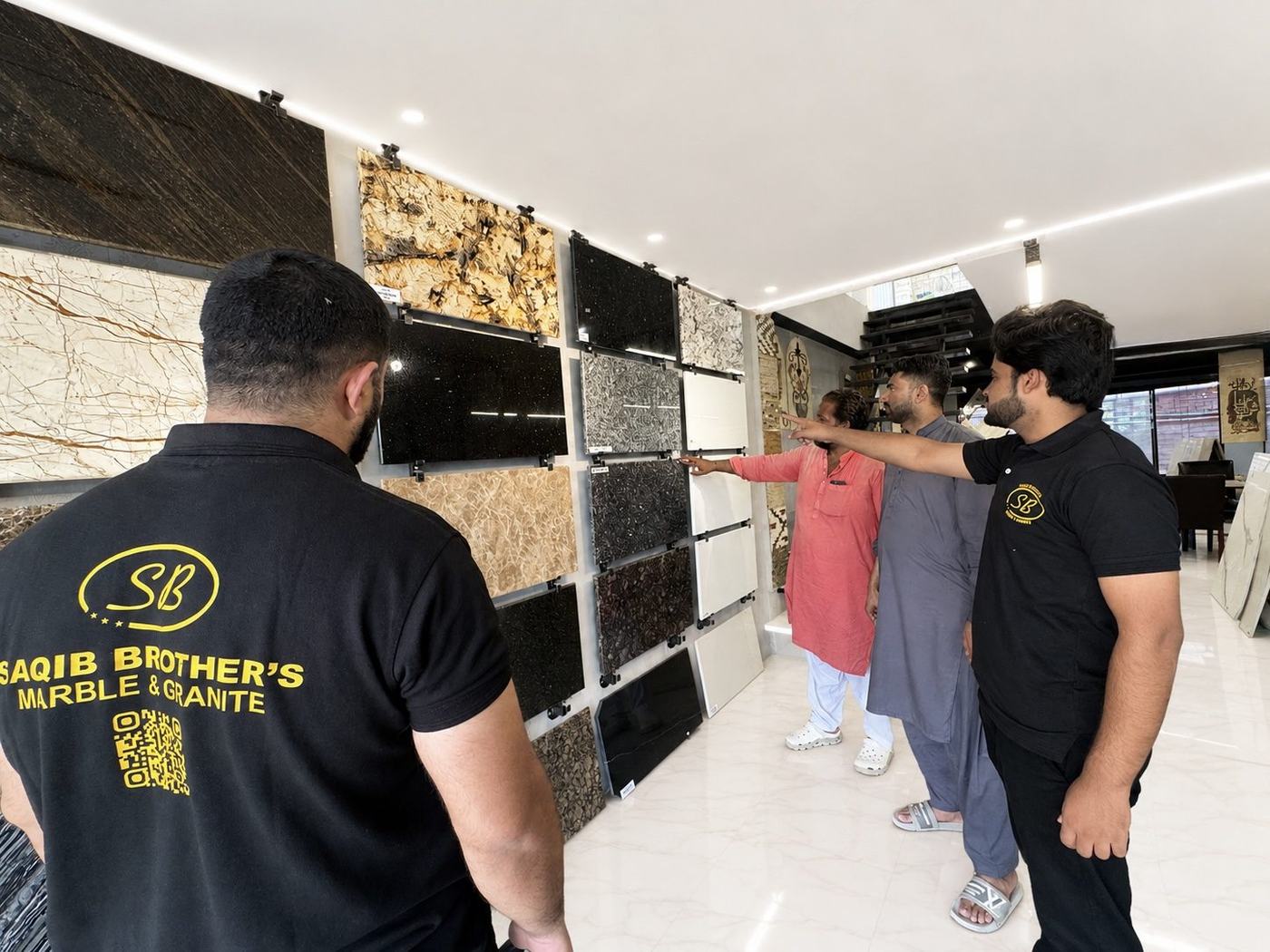
The showroom and factory on Main Canal Road, Rehman Pura, Harbanspura is where you should come to choose. Over five hundred full slabs stand upright on racks — marble, granite, onyx, travertine, quartzite and the rest of the fourteen collections — lit so you can read the movement across a whole slab rather than guess from a tile. Bring drawings, or send them ahead on WhatsApp and we will have your shortlist pulled and standing when you arrive. Open Mon to Sat, 08:00 to 19:00.
The production facility at RUDA — Turkey Road, near Chahar Bagh, off the Ring Road — is where the work happens: sixty-six thousand square feet of gang saws, CNC lines and polishing. It is a working industrial site rather than a shopfront, but clients with large or technical projects are welcome to see their material being cut. Several of our corporate clients ask to, and we would rather they did.
Between the two, a project moves from raw block to finished installation without leaving our hands. Thirty years, four thousand projects, and the same family running both.
Harbanspura gallery — 500+ full slabs, Mon–Sat 08:00–19:00.
RUDA facility — 66,000 sq ft, by appointment.
WhatsApp your drawings — itemised quotation, usually same day.
Questions we answer daily
Are you a marble factory or a shop?
A factory. We buy blocks at the quarry and at origin, saw them on our own gang saws, polish them on an eight-stage line and cut them on Italian CNC at our 66,000 sq ft RUDA facility. The Harbanspura site is a showroom attached to a working factory, not a retail counter buying in finished slabs.
Where is your marble factory in Lahore?
Two addresses. Showroom and factory: Main Canal Road, Rehman Pura, Harbanspura. Production facility: RUDA Industrial Zone, Turkey Road, near Chahar Bagh, Ring Road. Come to Harbanspura to choose stone; RUDA is a working industrial site and best visited by arrangement.
Is buying from a factory cheaper than a shop?
Usually, because you pay one margin instead of several. But the larger benefits are consistency across big floors — we can reserve a single quarry lot for your project — and accountability, since there is no third party for us to blame if something is wrong.
Can I visit and watch my stone being cut?
Yes. Clients with large or technical projects are welcome at RUDA to see their material on the line, and several of our corporate clients make a point of it. Arrange it with us first so the relevant work is scheduled while you are there.
Do you do custom cutting and edge profiles?
Yes — mitred corners, bullnose and ogee profiles, cut-outs for sinks and hobs, drainage grooves, anti-slip grooving on stair nosings, and inlay work. All cut on the CNC to your drawing at ±1 mm, before delivery, so no cutting or dust happens on your site.
How long does a typical order take?
It depends on whether the stone is in stock and on the fabrication involved. Material already on our racks can be cut and delivered within days; a block that needs sawing and polishing takes longer. We give a date in the written quotation and we work to it — for commercial jobs we phase deliveries to your site programme.
Do you supply other contractors and fabricators?
Yes. Alongside direct clients we supply builders, interior contractors and fabricators across Punjab, in slab form or cut to size. Trade enquiries are welcome — send the specification and quantity and we will quote.
Do you handle export orders?
Yes — container-scale dispatch from Karachi Port to over forty countries, with full documentation. Ziarat White and Black & Gold are our most requested export stones.
Ready when you are