
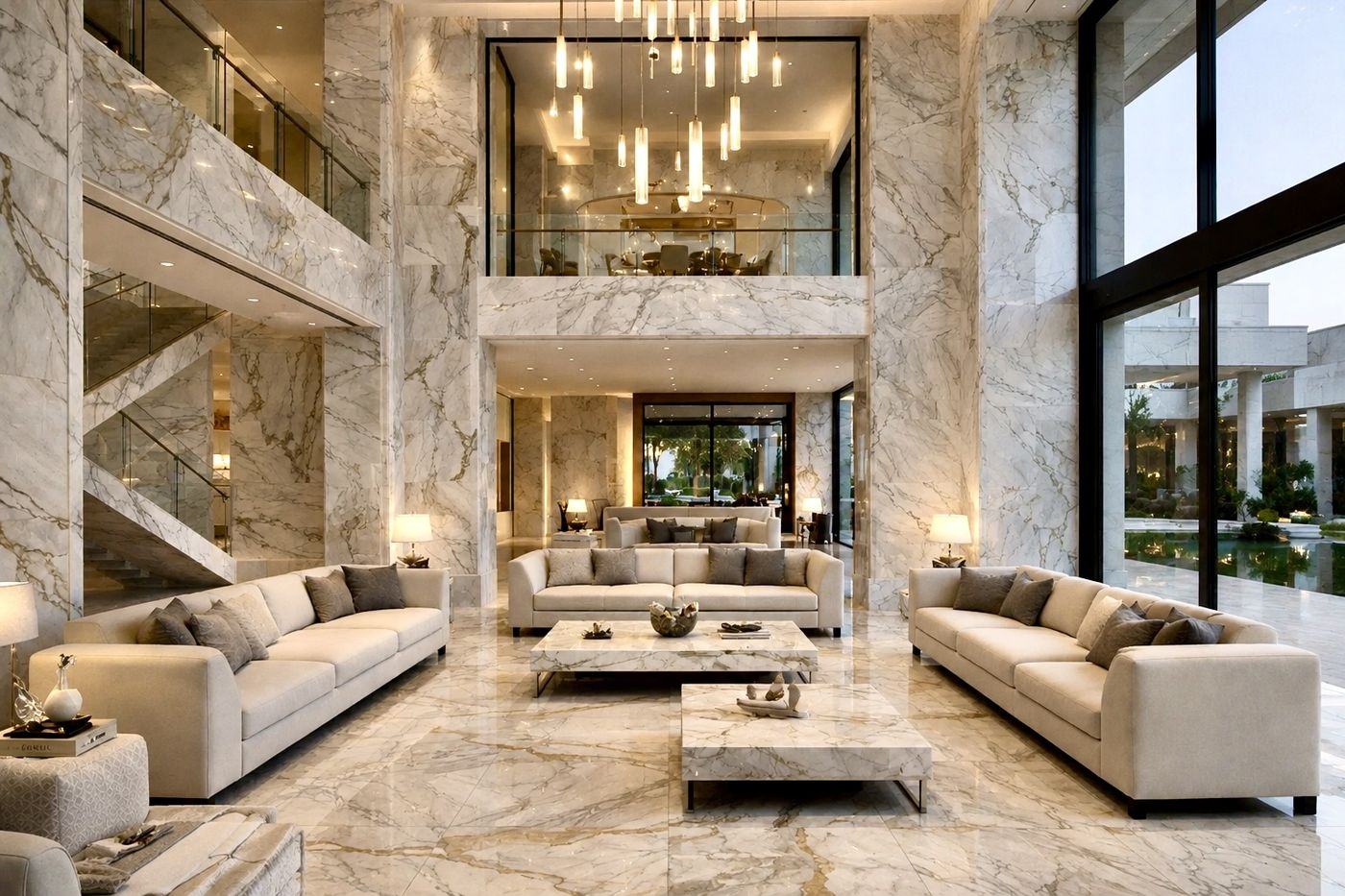
The Definitive Ranking · 2026
The Best Marble
in Pakistan.
Ranked not by a blogger, but by the house that has cut, polished, and installed it since 1995 — four thousand projects deep.
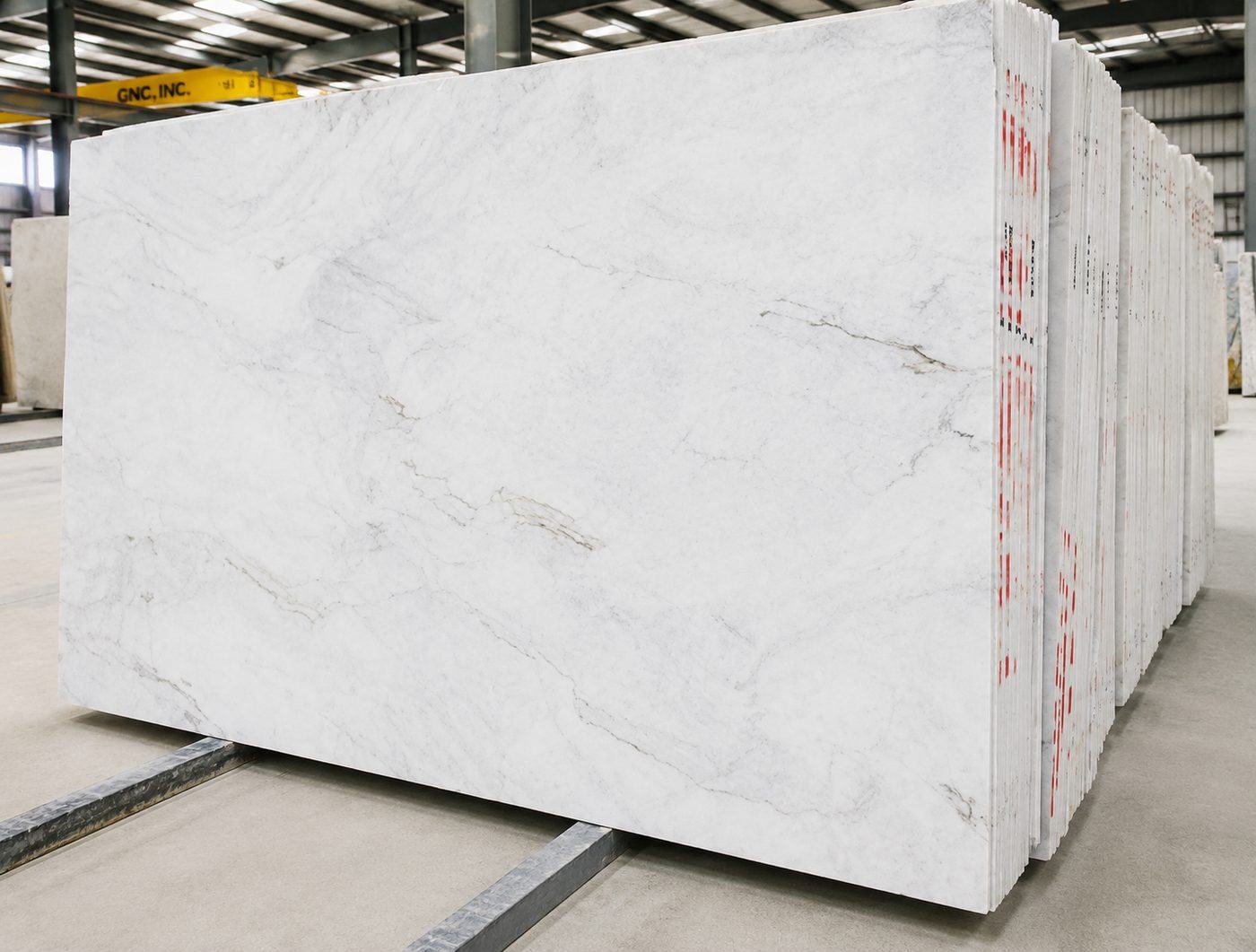
Judged at the saw,
not the showroom.
Every stone below has passed through our own gang saws and polishing line. We know which whites hold their gloss through a Punjab summer, which blacks forgive a dropped karahi, and which imports are worth the ocean they crossed. That knowledge — not marketing — built this ranking.
It also means the ranking is not a list of the most expensive stones. The most expensive marble in Pakistan is easy to name and almost never the right answer. What follows is ordered by how well each stone actually serves the job most people are buying it for: a floor that has to look right for twenty years in a house where people live.
One caveat worth stating plainly at the top. Pakistan is not one climate. Karachi is humid and carries salt in the air, which is hard on some stones and irrelevant to others. Islamabad and the north get genuine winters and freeze-thaw on exposed terraces. Lahore and central Punjab are dry, dusty and brutally hot, with hard water in the supply. A stone that is right in one of those places may be a poor choice in another, and any guide that ignores this is not really a guide.
Where that changes the recommendation, we have said so under the stone rather than pretending one answer covers the country.
The Ranking
Judged in order.
01Ziarat White
Best All-RounderPakistan’s flagship white and the stone we specify more than any other. Dense for a white marble, which is exactly why it survives: a tighter surface takes up less water, resists staining better and holds its polish through years of washing. It gives you the cool luminous quality people arrive asking for when they say “something like Carrara”, at a fraction of the landed cost, and it works in every climate zone in the country. It floors more mosques, staircases and family homes than any other stone in Pakistan, and it belongs at number one without argument.
Explore → 02
02Black & Gold
Best StatementJet-black ground struck through with golden lightning, and the country’s most recognised export marble — the stone that has done most to build Pakistan’s reputation abroad. Its place is a feature wall, a stair riser, a reception face, a mihrab: somewhere it will be looked at rather than walked on with grit underfoot. Used as a full floor in a busy household it shows every mark. Used as the one dramatic gesture in an otherwise quiet room, nothing else comes close.
Explore → 03
03Statuario
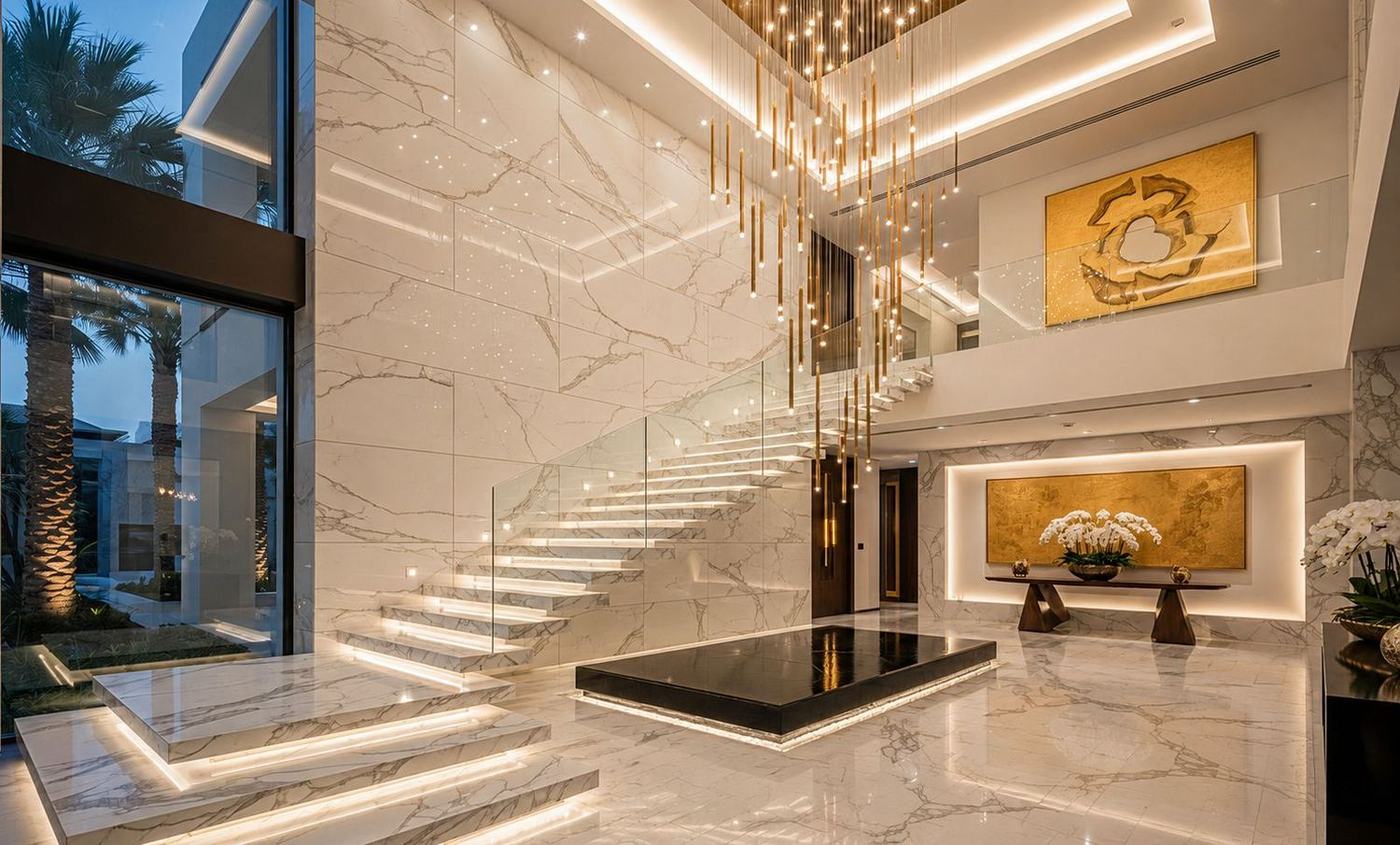
Best Luxury WhiteThe emperor of Italian whites, and the only entry here we recommend on aesthetics rather than performance. Bold grey veining on a bright ground, made for book-matched double-height halls where the wall is the architecture. It costs what it costs and it is softer than Ziarat, so it belongs in formal spaces rather than kitchens and entrances. Nothing else photographs like it, which is precisely why people choose it.
Explore → 04
04Sunny Grey
Best Value FloorThe workhorse that quietly floors more of Pakistan than anything on this list. Even-toned mid-grey, endlessly available in consistent lots, and forgiving in a way no white can be — dust does not read as dirt, water marks disappear into the field, and a scuff waits for the next polish rather than announcing itself. If you are covering a whole ground floor and want natural marble rather than tile pretending to be it, this is the sensible route.
Explore → 05
05Carrara White
Best Imported ValueCooler and finer in its veining than Statuario, and meaningfully less expensive — which across a large floor funds the fabrication quality that actually decides how the finished job looks. It carries genuine Italian provenance for clients who want it. Honest caution: it is softer than Ziarat and less tolerant of hard water, so we steer it toward bedrooms and formal rooms rather than kitchens, entrances and anywhere mopped daily.
Explore → 06
06Botticino
Best Warm ClassicCream-beige with fine fossil detail, and three decades of Pakistani drawing rooms and hotel corridors have not been wrong about it. Its warmth sits comfortably under the yellow-tinted evening light most homes here use, where cooler whites can read grey and unwelcoming. It is also genuinely forgiving of hard water, because the marks that would show on a bright white lose themselves in the stone’s natural variation.
Explore →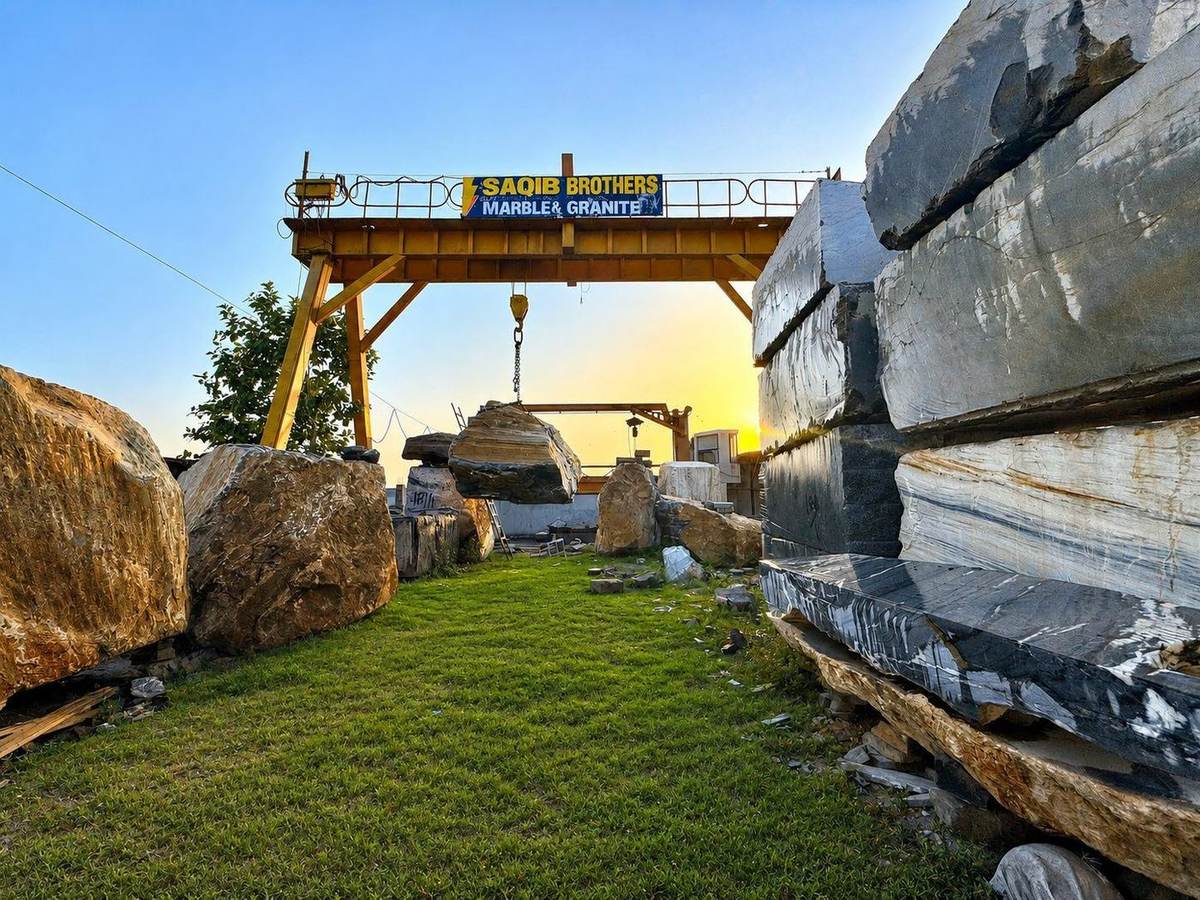
Local or imported —
the honest economics.
The question we are asked more than any other is whether imported marble is better than Pakistani marble. The truthful answer is that it is a question about looks, not quality, and conflating the two costs people a great deal of money.
Pakistani stone is not the budget option because it is inferior. It is less expensive because it has not crossed an ocean, cleared a port, or paid duty. Ziarat White is denser than several Italian whites and copes with our water and heat more comfortably than most of them. If durability in this country were the only criterion, local stone would win most of the time.
What imports genuinely offer is veining that Pakistani quarries do not produce. Statuario’s bold grey rivers, Calacatta’s gold, the specific character of a Volakas or a Crema Marfil — those are geological facts of where the stone formed, and no local alternative reproduces them. When a client wants that particular look, importing is the only route, and we import it.
Where people lose money is in the middle: paying imported prices for commercial-grade imported stone that has been resin-filled to hide fissures or colour-enhanced to fake a higher grade. A great deal of “Italian marble” in this market is exactly that. It is legitimate when disclosed and quietly dishonest when it is not — and it is why we insist clients see the actual lot rather than a photograph.
“We will talk you out of the wrong marble as readily as into the right one — reputation outlasts any sale.”
How to buy it
without getting caught.
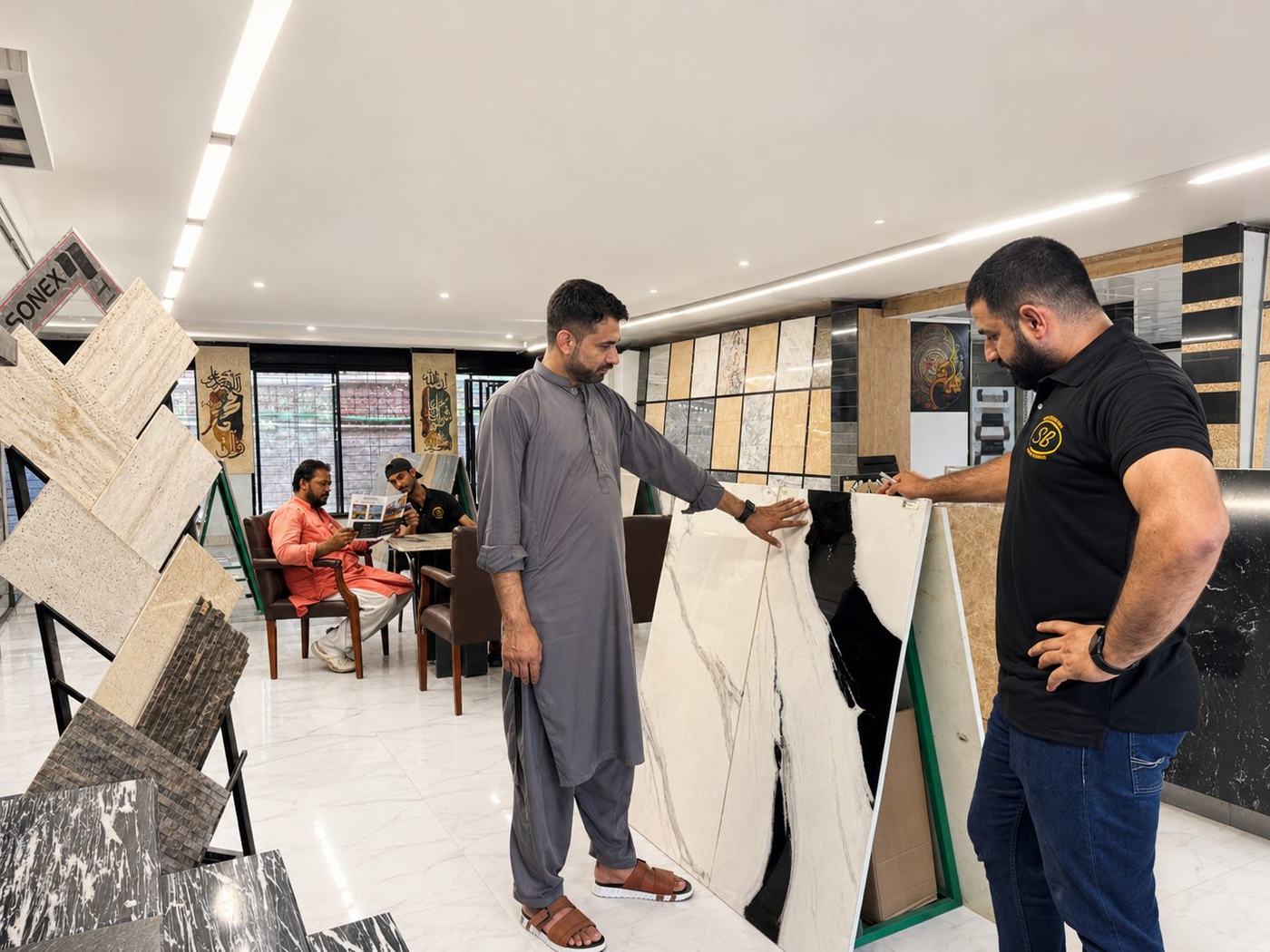
Four questions separate a quotation you can trust from one you cannot, and none of them require any knowledge of stone. Ask them of us and of everyone else you are considering.
What thickness is this? Sixteen millimetre and twenty millimetre marble are different products, and a 16 mm slab quoted at a 20 mm price is the most common way a number flatters itself. Twenty millimetre belongs on ground floors, entrances and stairs; sixteen is acceptable upstairs and in light-use rooms.
What wastage percentage is assumed? Every stone job loses material at cuts and corners. A quote that pretends otherwise finds the difference later, in a variation you did not agree to. And is the rate per square foot of material, or fitted? A fitted rate should state base preparation, edge work, skirting, and who carries the risk on breakage.
Has the stone been filled or dyed? Both are legitimate treatments, routinely used, and both should be disclosed. Resin filling stabilises a fissured slab; colour enhancement deepens a tone. Neither is a scandal. Selling either as a natural premium grade is. Finally: can I see the actual lot my order will come from? Stone varies between lots, and a sample cut from a different batch tells you very little about what will arrive on your floor.
Ziarat White — local strength, imported looks, every climate zone.
Statuario, book-matched, nothing else.
Sunny Grey — forgiving, consistent, genuinely available.
Indicative Rates · PKR per sq ft
What it costs,
honestly.
We deliberately do not publish a fixed rate per stone. Any exact figure printed on a website is out of date within months — the currency moves, quarry output changes, and a number that was honest in spring quietly misleads by autumn. Ranges are the truthful form: they show you where our rates actually sit without claiming a precision that does not survive contact with the market. These bands shift too, which is why the only figure that binds either of us is the one written on your quotation.
| Stone | Cut-to-size / flooring | Full slabs |
|---|---|---|
| Ziarat White | Rs 120 – 500 | Rs 600 – 2,500 |
| Sunny White | Rs 100 – 150 | Rs 350 – 600 |
| Sunny Grey | Rs 75 – 95 | Rs 200 – 450 |
| Badal | Rs 75 – 95 | Rs 200 – 450 |
Why the ranges are wide — the same stone prices very differently by format and grade. Cut-to-size flooring, full slabs, stair treads, vanity tops and full gangsaw pieces are effectively four different products from one block. Grade within a stone varies as much again.
Ranges shown for guidance. The price we quote in writing is the price you pay.
Questions we answer daily
Which marble is best in Pakistan?
For most homes, Ziarat White. It is dense, holds its polish, resists hard water better than most imported whites, and gives the cool white look people want at a fraction of the landed cost of an equivalent Italian stone. For statement interiors where veining is the point, imported Statuario leads.
Is Pakistani marble better than Italian marble?
For durability in Pakistani conditions, frequently yes — Ziarat White is denser than several Italian whites. Italian stones win on veining that our quarries simply do not produce. It is a question about appearance, not quality, and treating imported as automatically superior is how people overpay.
Which Pakistani marble is most expensive?
Premium lots of Ziarat White and Black & Gold command the highest local prices, driven by lot quality rather than variety alone. Imported Italian whites sit above both. Indicative bands are published above; the exact figure depends on format, grade and thickness and is confirmed in writing.
Does the right marble change by city?
It does. Karachi’s humidity and salt air are hard on porous stones; the north sees genuine freeze-thaw on exposed terraces; central Punjab is dry, dusty and hot with hard water. Ziarat performs well in all three, which is part of why it ranks first. Softer imported whites need more thought outside temperate interiors.
What is the difference between filled and unfilled marble?
Filled marble has had natural fissures stabilised with resin — a routine, legitimate treatment that makes some slabs usable. The issue is disclosure. Heavily filled or colour-enhanced commercial grade sold as premium natural stone is common in this market and is exactly why you should see the actual lot before buying.
Which marble is best for stairs?
Ziarat White for most projects — dense enough for the traffic, bright enough to keep a stairwell open. Use twenty millimetre with a solid nosing, and have anti-slip grooving cut at the factory rather than improvised on site. Black & Gold makes an excellent riser paired with Ziarat treads.
Can I use marble in a Pakistani kitchen?
On the island face or splashback, yes. On working counters we usually advise against it — turmeric, lemon and vinegar all etch calcite, and a Pakistani kitchen produces all three daily. Granite or quartzite belongs where the knives land.
Do you export Pakistani marble?
Yes — Ziarat White and Black & Gold are our most requested export stones, dispatched container-scale from Karachi Port to more than forty countries with full documentation.
Why don’t you publish exact prices?
Because a fixed figure on a website is misleading within months — currency, freight and quarry output all move, and a rate that was accurate when it was typed quietly becomes a false promise. Ranges are the honest version: wide enough to stay true, narrow enough to be useful. Even these bands change with market conditions, so the figure that counts is the one we put in writing against your measurements.
Ready when you are